WELCOME TO SELMA

“AS AN ADVOCATE FOR ALL BUSINESSES, SMALL AND LARGE, THE CHAMBER INVITES YOU TO JOIN OUR MEMBERSHIP TEAM OF ENTHUSIASTIC COMMUNITY LEADERS WORKING TOGETHER TO SHOWCASE SELMA AND DALLAS COUNTY'S LOCAL BUSINESSES, ATTRACTIONS, AND QUALITY OF LIFE.”


 - EXECUTIVE DIRECTOR, SHERYL SMEDLEY

news

By Faith Callens May 31, 2026
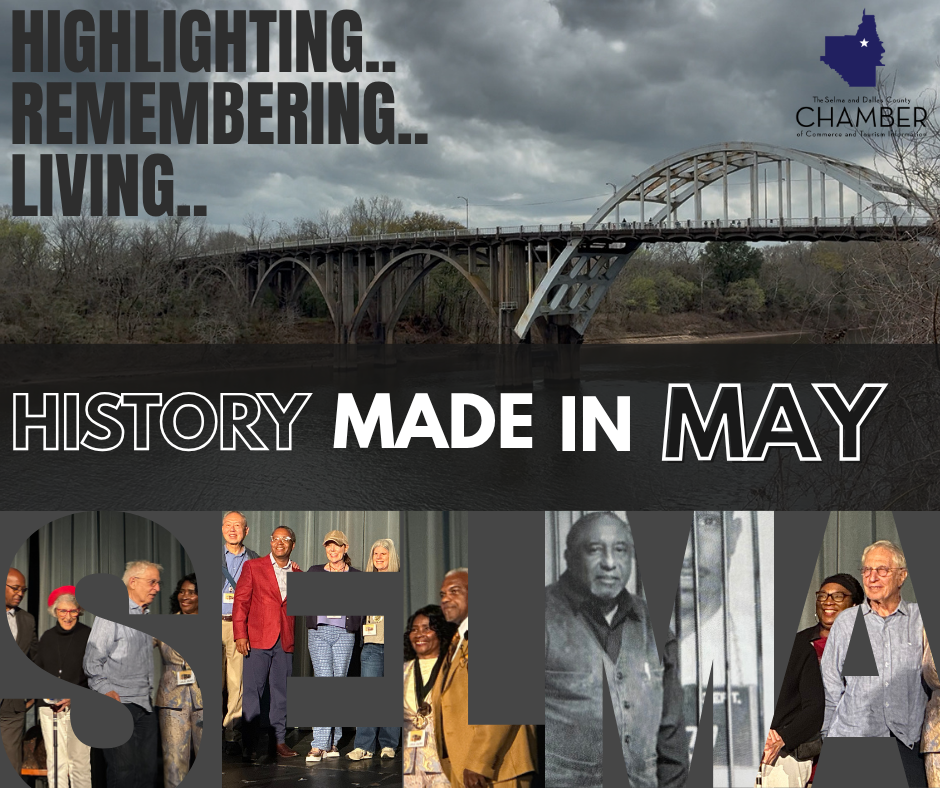
The Selma and Dallas County Chamber of Commerce and Tourism Information highlights two events in May that were dedicated to commemorating the legacy and life of those who stood up for civil rights and social justice. | The Selma and Dallas County Chamber of Commerce and Tourism Information By Faith Callens Special to the Selma and Dallas County Chamber of Commerce and Tourism Information Throughout the month of May, Selma has observed several historical events honoring the legacy and life of those who stood up for civil rights and social justice. On Thursday, May 7, The Walton Theater held a powerful Broadway performance of the New York musical, We Shall Someday that highlighted the 65th anniversary of the iconic freedom rides and more than 400 riders who fought continuously for their right to be free despite the challenges of segregation. The stellar performance was brought to Selma by Foot Soldier Linda Holmes and her husband, Bruce Holmes, who previously saw the performance for themselves in New York City and decided to partner with the musical’s executive producer, Mandy Hackett, including the City of Selma Mayor Johnny Moss, III, and Selma Pastor John E. Grayson to bring such a powerful and moving performance to the residents of our queen city. “There’s nothing like being here,” said Dorothy Walker, Moderator of the historical performance. “In this place, in Selma, in the State of Alabama and in the United States. But I will tell you like I used to tell people during tours who came to the museum that it takes on a new meaning, this place. When we are here with those who sacrifice so much for us to have this moment and to be where we are today, 65 years later. And so, in this moment, we want to honor them and their sacrifice, their courage to do what they did 65 years ago. To get on buses, trains and planes to come into the South or [travel] throughout the South.” As the program went on, Walker had all the courageous freedom riders in the room and all participating civil activists back then to stand near their seats in the theater, so the audience could pay homage and tribute to them as well. Walker also recognized each freedom rider individually and told their story to the public of just how they made the courageous choice to become such a historical figure in the movement. The first name she called was Mrs. Linda Holmes. “Mrs. Linda Holmes, born and raised in Selma, Alabama,” Walker said. “Linda Dickerson Holmes lived in the George Washington Carver Homes Housing Project a.k.a GWC in apartment 528 D. This housing project is also known as the face of the Civil Rights Movement and she decided to join protest marches at the young age of 11.” Walker continued by saying, “Her first steps into the movement were small and practical. It began at the Historic Brown Chapel A.M.E. Church, where Linda is still a member to this day. One day prior to entering the church, the Rev. Dr. Martin Luther King, Jr. spoke to Linda and he shook her hand.” Walker said it was a moment Holmes never forgot throughout her life and she proceeded to say, “Linda was awarded the Foot Soldiers medal at the [2026] Foot Soldiers Breakfast by the late great civil rights activist Ms. Joanne Bland.” Walker didn’t just stop there. She introduced Ms. Carol Ruth and told her story of only being 22 years old and that she worked as a clerk at the United Nations in New York City when she decided to join the freedom rides. She also introduced Freedom Rider Robert Cullen who was a sophomore at Tulane University and a member of the New Orleans Chapter of the Congress of Racial Equality where he was one of the first graduates of the New Orleans Freedom Rider School. Walker said the school trained activists to join the rides after riders were attacked in Montgomery. Near the end of the historic event, there was a powerful panel discussion that consisted of Moss, Walker, Ruth, Grayson, Cullen and Holmes that led to the discussion of just how far Selma has come since the movement in 1965. The night ended in reflection, prayer and hope for the current generation of people to continue fighting just as the freedom riders did back then for the right to be free. On Wednesday, May 13, the Historic Tabernacle Baptist Church in Selma held its memorial tribute honoring the life and legacy of Rev. Dr. Bernard Layette, Jr. and the 63rd Observance of the Voting Rights Movement’s First Mass Meeting. This historical event opened with songs from the Selma Foot Soldiers Singers to an opening word from the HTBC Senior Pastor Rev. Dr. Otis Dion Culliver and a scripture reading was provided by Foot Soldier Rev. Ocie Acoff. There was also a moment of prayer provided by Foot Soldier Rev. Eddie Marshall and the ceremony’s greetings was provided by Selma’s Honorary Mayor Johnny Moss,III alongside several other elected officials including a representative from U.S. Rep. Terri Sewell’s office, Byron Evans. “Today we gather, not just to remember a man but to honor a movement, a mission, and a legacy to help change America forever,” Moss said. “We are here today to pay tribute to Rev. Dr.Bernard Lafayette, Jr., a giant of the civil rights movement, a strategist of non-violence and a servant leader whose work helped shaped the course of history. Dr. Lafayette, Jr. stood the front lines doing one of the most defined periods in our nation’s history.” As Mayor Moss went on, he reflected on the courageous efforts of Dr. Lafayette by saying, “he organized, he marched, and he taught the sacrifice because he believed ordinary people could create extraordinary change.” Like Moss, there were several other reflections of Dr. Lafayette’s efforts from speakers such as Attorney Charles Bonner who spoke about the voting rights movement beginnings to Rev. Culliver’s own reflections on the behalf of HTBC to Mr. Charles Mauldin, the Student President of the Selma movement from 1963 to 1965, who shared his personal experiences knowing Dr. Lafayette and the mission he stood for as well. There were also other reflections from Rev. Dr. Charles Steele, President Emeritus of the Southern Christian Leadership Conference (SCLC) and Attorney Ainka Jackson,Executive Director for the Selma Center for Nonviolence, Truth and Reconcilation organization. Not only did Jackson speak about Dr. Lafayette and his life but she had a mini-nonviolence teach-in session for the public that broke down the six principles of nonviolence and the six steps of Kingian Nonviolence that were used by Dr. Martin Luther King, Jr. during the marches and nonviolent campaigns for freedom. The event ended in song by the Selma Foot Soldiers Singers and an another memorial tribute was provided by Honorary Alabama Senator Emeritus Hank Sanders and words of gratitude was given by the family of the late Rev. Dr. Bernard Lafayette, Jr. These events that took place in the month of May were both significant and crucial to our Selma history and also our American history and we at the Selma and Dallas County Chamber of Commerce and Tourism Information are proud to share two historical events in our community among many that have taken place this month.
By Faith Callens April 14, 2026
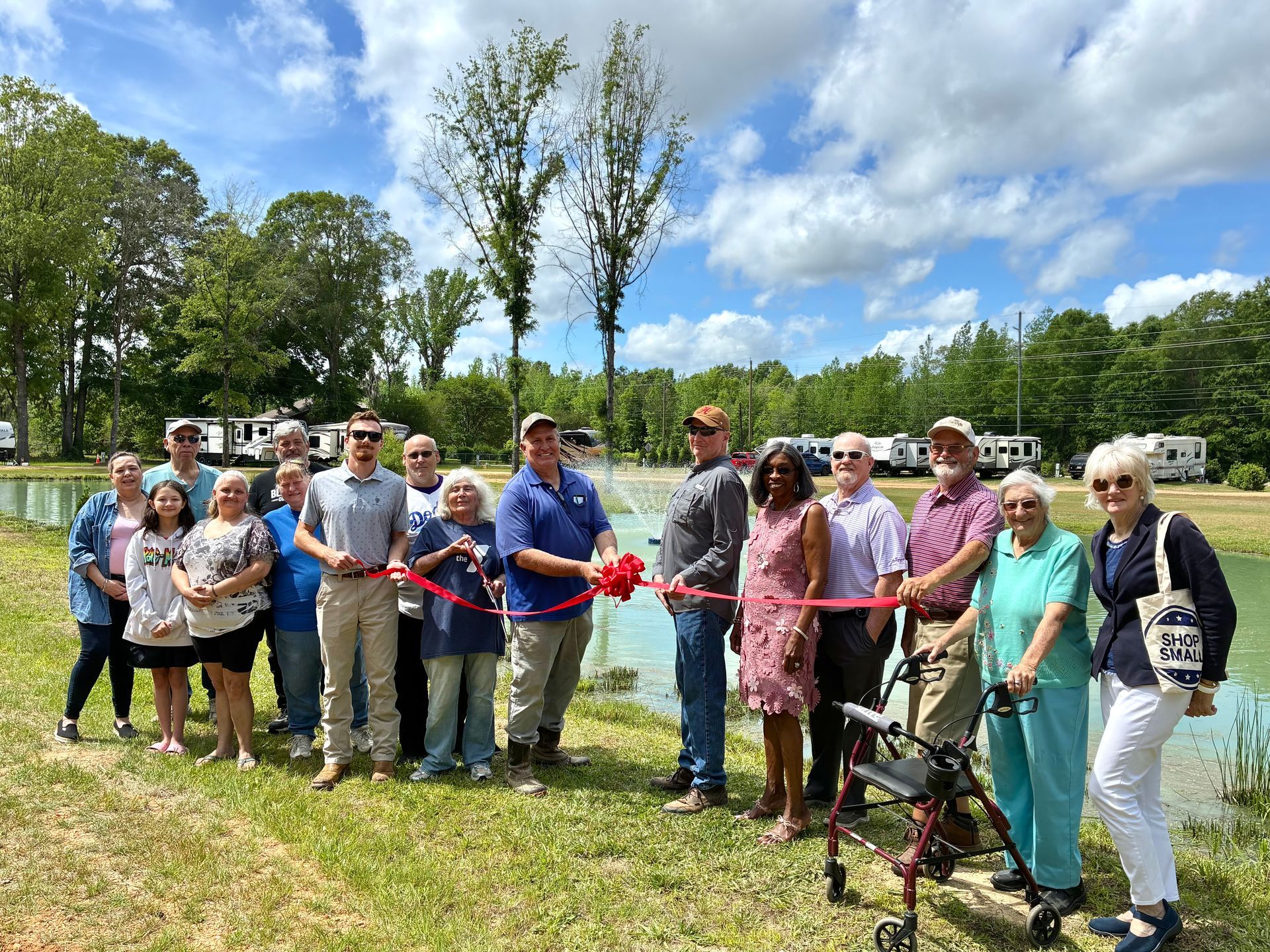
On Monday, April 13, The Selma and Dallas County Chamber of Commerce and Tourism Information celebrated the grand opening and ribbon-cutting ceremony for Selma's newest RV park, Paradise Cove RV Park. | The Selma and Dallas County Chamber of Commerce and Tourism Information By Faith Callens Special to the Selma and Dallas County Chamber of Commerce and Tourism Information It’s a beautiful day in the Selma community, and we at the Selma and Dallas County Chamber of Commerce and Tourism Information showcase you to the grand opening and the ribbon-cutting ceremony of the Paradise Cove RV Park. The Paradise Cove RV Park is located at 1902 Alabama Highway 14 East that encompasses room for about 50 RVs, and it is owned operated by three generations of the Maluda family, Tyson and Sherry Maluda, Gary Maluda and his son, Alex Maluda. Gary Maluda is the primary owner of Selma’s newest RV park and said this park is just an extension of what his family has done for the Selma community overall. “Mom and dad started the RV business back in the mid-80s,” Gary said. “After college I joined in and now my son Alex has joined in and with the current RV Park on Highway 14 that we have, we mostly cater to contractors.” Gary said that the contractor tenants are the perfect tenants for the park because they work hard, sleep often and are continuously seeking a nice place to stay. So, in turn, he said with his park, he tries to provide them with a good, nice and affordable place to stay. “We also cater to the college students,” Gary said. “Lot of times, students come into Selma, and they can’t sign a year lease, or they just want to stay for a semester, parents should get an RV and allow them to stay with us.” Gary said providing housing to college students and contractors has always been a major benefit to them and that it is a business that he and his family have come to enjoy. “We love working with these people,” Gary said. “They are the perfect tenants, and I guess it’s been going on over 40 years since we’ve been doing it.” Gary said the park is just minutes away from the heart of Selma and is a convenient RV park for those who are interested in a quiet, peaceful resting place during their stay. “It’s convenient to Downtown Selma,” Gary said. “The food, Walmart and all the shopping. But it’s just outside of town. It’s not far from Bush Hog, the International Paper, Alabama Power and so it’s very convenient to the industry. It’s right here, off the main road, near the bypass and we have a full five-bar cell phone coverage. It’s just a convenient place where we have cleared the lot, built a pond, installed a fountain with led lights and a lot of these contractors bring families with them, so it’s a nice place to stay while the spouse is at work.” Gary said he also feels his RV park, Paradise Cove, will help Selma retain revenue and allow visitors to keep their spending efforts in the city. “These customers are a great injection to the city,” Gary said. “They come here with their families, most of them, they spend money here whether it’s shopping, eating out and I believe it’s just a shot of energy to the city of Selma.” Gary said through his business and the love that he has for his hometown, he feels that his RV Park will benefit Selma greatly and help its economic impact along the way. “Paradise Cove RV Park is very affordable,” Gary said. “We price by the day, by the week, and most of the contractors stay for at least a month.” Our price to stay is $500 a month and that includes everything from power, water, sewage and we have sites with shade trees and open sun.” Cherie Garcia said she has been a resident of the park for five months and she said during her residency there she always sees Gary Maluda doing something around the park to help keep the area nice and clean. “It’s peaceful and nobody bothers you,” Garcia said. “I mean, I can go and sit and look at the ducks or the geese or whatever fly in the pond and my husband comes home and it’s quiet. It’s nice and peaceful.” Gary said travelers who are interested in visiting Selma or coming for a longer stay with their RV can call the Paradise Cove RV Park at 334-719-5147.
By Faith Callens April 1, 2026
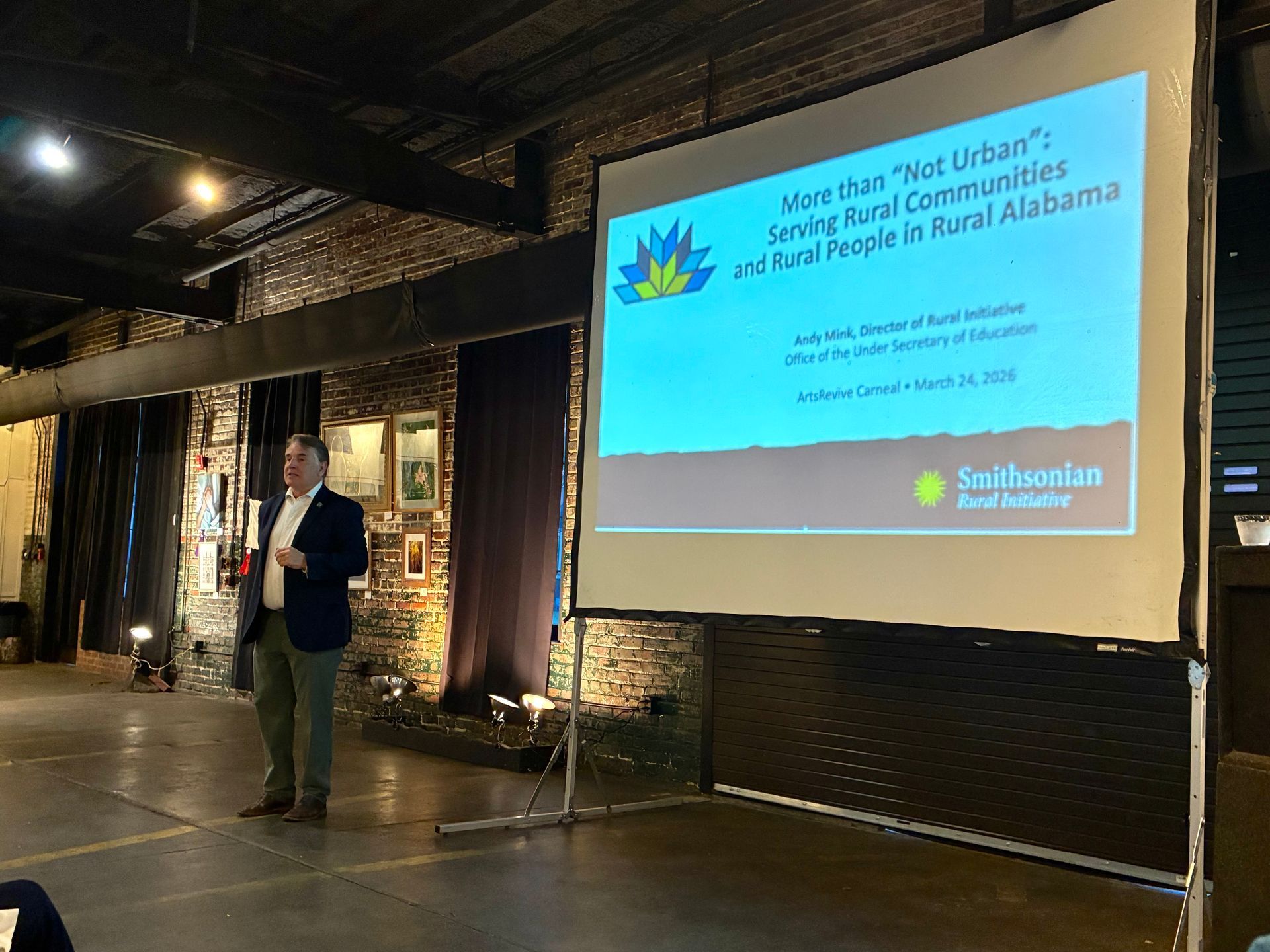
On Tuesday, March 24, the Smithsonian’s RI Director Andy Mink came to Selma to introduce the Smithsonian Rural Initiative to its residents and talk about the potential partnership in the community. | Selma and Dallas County Chamber of Commerce and Tourism Information By Faith Callens Special to the Selma and Dallas County Chamber of Commerce and Tourism Information On Tuesday, March 24, Smithsonian’s Rural Initiative Director Andy Mink came to Selma on the behalf of Arts Revive Director Becky Youngblood to speak with residents and community partners about the Smithsonian Institution and its efforts toward rural communities. Mink told the community that the presentation called “More than “Not Urban”: Serving People and Places in Rural Alabama” was for the city of Selma as whole, its citizens and its community leaders to sort of think about ways that the Smithsonian Institution in Washington, D.C. could really be an authentic partner. Mink told the history of the Smithsonian Institution and its foundation to give the Selma community a closer look at what the institute is and what it stands for. “So, the Smithsonian itself is nearly 180 years old,” Mink said. “It was founded with a gift from Britain. James Smithson gave his fortune to the United States to start the Smithsonian Institution, and his sole directions were to create an organization for the increase in diffusion of knowledge among men.” Mink said the same ideology that Smithson had for the Smithsonian Institute nearly two centuries ago is the same ideology that is embedded in and deep rooted in the spirit of the Institution and its work as we know it today. “One major misconception that I hear is that the Smithsonian is a single building, a single museum and that you come to Washington, D.C. and you walk into this single doorway and you have this singular experience in the U.S.,” Mink said. “But of course, the Smithsonian, instead, is a massive institution of 6,000 employees, of 21 museums of the National Zoo and 14 education and research centers. So, this facility itself is really globally known, recognized and massive. I say “massive” actually in the best possible use of that term right now and it is an organization with expertise in a wide variety. 7 million objects in our collection but only 1 percent are on the supply.” Mink continued by saying, “That I’ve been told and I have heard from historians who work at the Smithsonian that that’s only about 15 percent of objects and artifacts that make up the American story and all the rest of them are sitting in shoe boxes underneath your bed.” As Mink’s presentation went on, he showcased several artifacts and objects that the Smithsonian has to the public such as the desk that Thomas Jefferson carried until his death in 1825. “Then Jefferson wrote the Declaration of Independence, then all of a sudden, this pile of wood becomes a much different shazam moment,” Mink said. “It becomes something that illustrates the birth of this country and of American Democracy and the ways that we imagine the community that we live in.” Speaking of communities, Mink went from the exploration of artifacts and objects that you could see in the Institution in D.C. to a much tighter view of scope, speaking about the effect the Institute has on rural and small-town communities. “We currently have three institutions in Alabama who are apart of our [ Smithsonian Affiliates Program],” Mink said. I think of it a little bit as a co-op, where you are a part of a membership, you have access to Smithsonian branding, Smithsonian resources, Smithsonian speakers and Smithsonian amplification.” Mink then gave examples of how the Smithsonian can be in Huntsville, Birmingham and Anniston, Alabama and he also spoke about a popular program that the Institution has called MOMS (Museum on Main Street). “For thirty some years, MOMS has been sending traveling exhibits to small towns all over the country that share exhibits that usually are six to 800 square feet. They are relatively small and my good friend Becky Nichols of the Selma and Dallas County Library hosted one of these in the past where the exhibit comes and spends maybe six weeks. There’s a big topic that all small towns can communicate around. It’s waterways, crossroads, its innovation and the idea isn’t necessarily to come and see an exhibit. The idea is to come and interact with the exhibit about where you are from, to be inspired, to talk to the people you are with about crossroads, that train you got stuck behind, to talk about innovation and the people that we are.” Mink went on to talk about the Smithsonian’s digital footprint and how the three-year rural initiative program came into effect to help smaller communities. “We receive about 30 million unique visitors every year,” Mink said. “These would be virtual speakers, webinars, instructional resources for teachers and different kinds of cohorts. We are always thinking of ways to expand our reach to the communities that we need to serve. But, this is where the rural initiative was initially conceived. This idea of being in every community and every classroom in America and how can the Smithsonian respond to the very unique characteristics of Rural America and not treat them as an afterthought and not sort of be unavailable because they are far away from Washington and the places that the Smithsonian sits." So, you may wonder how does Selma fit? Mink said through his presentation about the Smithsonian Rural Initiative and the examples provided through other smaller, rural cities that Selma could be a part of this initiative by first making the collaborative effort to work together with him and think about creative and meaningful ways to introduce the efforts of Smithsonian to Selma. “Let’s just start working together,” Mink said. "Earn each other’s trust, develop, contribute show up, not disappear.” So, number one, there are ways [ we can work together through] our shovel ready programs and I have shared some of them where we can start working in service of Selma almost immediately, through the library, school systems, through Mrs. Pitts, working with Mrs. Becky Youngblood in various ways.” Mink said there could be an arts and culture hub in Selma through the Smithsonian and through their shovel ready programs. He said they can immediately apply some of the things that they are doing in other smaller cities to Selma and become a part of its historic fabric. Mink also said another way that the Smithsonian could be involved in the frameworks of Selma is by being included in our events such as the annual Bridge Crossing Jubilee, our local galas or just through the service of being a part of our programs that impact our youth, our public library and our rotary club. “Would you like us to speak to them,” Mink told the crowd. “Would you like us to be a part of a brand application, not to bring money to us, but to amplify and improve your energy? Mink said the last way that the institution could work with Selma is through one puzzling question of, “How can we make something up together and both bring our skills and our expertise in the development of making Selma better? At the end of the presentation, Mink opened the floor for more questions about the Smithsonian and its rural initiative and brainstorming efforts from guests for the potential partnership in Selma. For more information about the Smithsonian and its rural initiative, visit https://www.si.edu/education/rural-communities

By Faith Callens March 30, 2026
On Monday, March 23, Mayor Johnny Moss, III highlighted several pillars of the city's progress during the State of the City Address held at the Carl C. Morgan Convention Center. | The Selma and Dallas County Chamber of Commerce and Tourism Information By Faith Callens Special to the Selma and Dallas County Chamber of Commerce and Tourism Information It’s been 100 days since Selma’s newest leader, Mayor Johnny Moss, III has been in office. On Monday, community members, city officials and employees of the City of Selma attended the state of the city address, awaiting remarks from Mayor Moss on the city’s progress. “This is not just a report,” Moss said. “This is a honest conversation about where we are, where we’ve been and where we are going as a city.” Moss said when he took office on Nov. 3 that him and team did not walk into a city that was not working but said it was a city that was working without structure. “Departments were working, but not always aligned,” Moss said. “Work was happening but not always tracked. Problems were being addressed, but not always resolved at the root and as we dug deeper, what became clear was this: good people were doing good work, but too often the work existed in silos. One department didn’t always know what the other was doing. Processes weren’t always documented and in many cases, success was depending on one person and not a system. “When knowledge lives in people instead of systems, you don’t have consistency. You have risk and we cannot build a future on risk.” Moss said the city operations had to be moved from “personality driven” to “system driven” and that it took a transition team that consisted of co-chairs and team members to make the city’s newest vision come to life. “These individuals gave their time, their expertise, and their honest perspective to help us understand where we are and because of their work, we are not guessing,” Moss said. “We are moving with clarity and that clarity led to action.” Moss said during his time so far in office that they have brought every department head together, not for any other meeting but to align their priorities. The four priorities Moss spoke about that he considers is crucial for the city are enhanced and accountable systems, visible improvements in the quality of life, the ability to strengthen public safety and trust and to continue the expansion of economic opportunity. Moss said with these four priorities in place, this is considered the first time that the city is moving in the same direction. The next pillar of Moss’s speech focused on the city’s systems and its finances. “Here’s the truth,” Moss said. “You cannot fix a city without fixing how it operates. When we took office, we knew that in order to move and settle forward, we had to build structure, build accountability and systems that work.” Moss said one of the most important steps that they are implementing right now is Open Gov. “This system will officially go live in October,” Moss said. “The work has already begun because implementing a system like Open Gov is not something you rush. It requires planning, training, data, organization and alignment across every department, and that’s exactly what we are doing now. We are preparing our departments, cleaning up our data, and building the internal structure needed so that when Open Gov goes live, it works.” Moss said when Open Gov is fully implemented, it will allow them to track revenue, expenditures in real time, monitor departmental budgets with greater accuracy and improve transparency for both leadership and the public while making more informed, data-driven decisions. “Because one of the biggest challenges cities face is not just revenue, its visibility and Open Gov changes that.” This system will work hand in hand with other changes we are making including strengthening internal financial processes, improving reporting standards and transitioning tax collections to the Alabama Department of Revenue. Because this is not just about one system. This is about building a complete financial infrastructure for the City of Selma. When Open Gov is fully implemented, we will have the ability to see what is coming into our city, what is being spent, and where adjustments need to be made and that means better decisions, better accountability and better results for our citizens.” Moss said that the new systems that they are implementing will allow the city to move from uncertainty to control. Moss also spoke about the city’s general fund and its budget. Currently, the city’s general fund is just under 21 million with approximately 10 million collected to date, according to Moss. “So that puts us at about 48 percent of our projected revenue, which means we are on pace,” Moss said. Our largest revenue drivers continue to be sales tax, business licenses and property taxes. But, here’s what we are focused on, not just maintaining revenue but growing it. Moss said one of the biggest structural changes that the city is making is transitioning to their department. “The state has stronger enforcement mechanisms, which means more accurate collections, more consistent reporting and less revenue falling through the cracks,” Moss said. “This is about making sure that Selma receives each dollar it is owed.” As the state of Address continued, Moss spoke to the public about several topics from the importance of businesses being licensed in the city of Selma to the focus of how the city plans to grow revenue in the right way. He also spoke about the importance of public safety. “Nothing matters more than the safety of our citizens,” Moss said. Since November, Moss said the fire department has seen real, measurable progress. He said the fire department has undergone a full operational restructure that has resulted in a 28 percent reduction in overtime, while still maintaining the coverage standards required to protect the city. “They have also hired six new personnel to strengthen their ability to respond and reduce the burden on existing staff and they have also taken the hard work of cleaning up the department’s finances, resolving over 40 outstanding purchase orders and debts, restoring accountability and credibility.” Moss said at the same time, the fire department has launched a new in service training program allowing firefighters to receive continued education while on duty, reducing costs and increasing readiness. Like the fire department, Moss also spoke on the Selma Police Department and his effort to work closely with the department to get them where they need to be. “This is an area where we all know there is still work to do and I’m not going to stand here and pretend otherwise, but I will say this, we have men and women in uniform who are showing up every day and doing a difficult job under difficult circumstances. They deserve to be supported. At the same time, we are focused on improving how we serve this community.” Moss said he is partnering with the Selma Police Department to strengthen staffing with new officers that are already added to the staff and will continue efforts to recruit and retain talent. “We are expanding community based strategies including neighborhood watch efforts and increasing engagement between police officers and residents. We are exploring new tools and technology like drone support for critical incidents to improve response and officer safety but more importantly, we are focused on building trust.” Moss said public safety is not just about enforcement but relationships, communication and ensuring that every citizen feels safe and heard. Moss also discussed the improvements of the city’s IT department and the various developments happening through the city’s parks and recreation department that he said would attract visitors and residents to fill up hotel rooms and restaurants around the city. He also spoke about the city’s public buildings and their functionality and how the public buildings department has made real progress by improving maintenance, responding faster to service requests and ensuring its facilities can support daily operations. He also highlighted the cemetery department, the Human Resources and Personnel department, the public works department and the planning and development department and its efforts in place to make Selma a better city. “Leadership is never a one person effort,”Moss said. "It takes a team and we are not where we want to be at but we are no longer where we are. We now have direction. We now have alignment and we are building the kind of system that will move this city forward.” For Mayor Moss's full state of the city address, visit the City of Selma’s Facebook page.

EXPLORE

Opportunities for exploration abound in Selma and Dallas County, Alabama. Locals and visitors alike often find themselves basking in our rich layers of history and abundant recreational opportunities. Whether you are looking for a journey through time or a relaxing getaway from the constant grind of big city life, Selma is the place for you. Come explore with us today.

A black and white drawing of an hourglass on a white background.

HISTORY

LEARN →
A black and white drawing of a pair of binoculars on a white background.

ATTRACTIONS

SEE →
A black and white drawing of a bicycle on a white background.

RECREATION

EXPLORE →
A fork and spoon crossed over each other on a white background.

DINING

INDULGE →
A black and white drawing of a bed with a blanket and pillows.

LODGING

VISIT →
The logo for selma and dallas county find it local live , shop , play.

STAY LOCAL

Looking for something? Think you should travel to find it? Think again!

VIEW THE GUIDE →
A logo for alabama black belt adventures

FEED YOUR ADVENTURE

Pack your bags and picnic basket and get ready for a delicious road trip!

GET STARTED →

StART YOUR BUSINESS

Selma and Dallas County boast a wide range of resources that ensure the success our small businesses. Let the Chamber guide you through the startup process by linking you with innovative, strategic solutions that can turn your idea into a thriving business. With the help of the Chamber and our trusted partners, you can start yours today!

LEARN MORE